
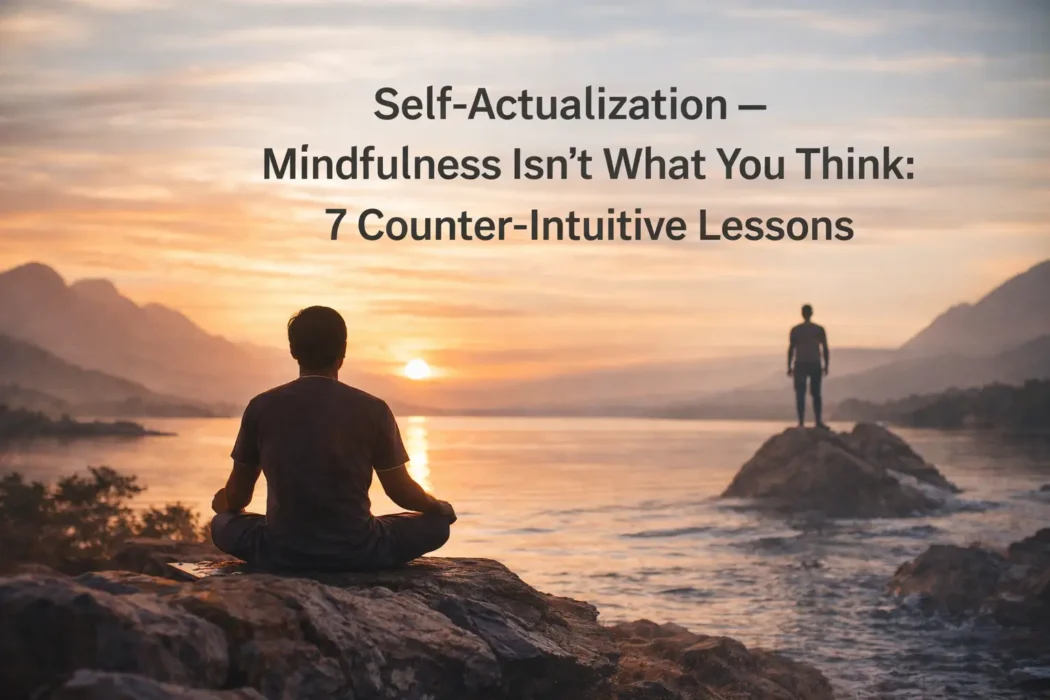
Self-Actualization- Mindfulness Isn’t What You Think: 7 Counter-Intuitive Lessons
Girish Jha, Coach and Guide, Eastern Wisdom . Blog for Self-Actualization
Most people come to mindfulness with a simple hope: “I want fewer thoughts. I want less anxiety. I just want some peace of mind.”
That’s a very understandable starting point.
But if you stay on the path long enough, something surprising begins to unfold. The purpose of mindfulness slowly shifts. It stops being about fixing the mind and becomes much deeper.
In the Self-Actualization journey, the focus gently moves from managing the mind to discovering the one who is aware of the mind.
This shift changes everything.
Here are seven insights from Eastern wisdom that often surprise people when they first encounter them.
Self-Knowledge, Not Calmness, Ends Suffering
Many people assume the goal of mindfulness is calmness.
Calmness is helpful, of course. But according to the teachings of Vedanta and other Eastern traditions, calmness is not the final goal—it’s more like a side effect.
What truly ends suffering is self-knowledge.
When you recognize your deeper nature—the awareness that is always present behind thoughts, emotions, and experiences—something fundamental changes. Suffering is no longer experienced in the same way because your sense of identity shifts.
As one teacher puts it simply:
“When I know my real Self, I know it. Finished.”
It isn’t information. It’s recognition.
The First “Power” Is Fearlessness
In popular culture, spiritual awakening is often associated with special abilities or mystical powers.
But the wisdom traditions say something very different.
The first real sign of awakening is fearlessness, especially the gradual disappearance of the fear of death.
Not dramatic heroism.
Just a quiet freedom inside.
When you begin to understand that your essential nature is not limited to the body and mind, the deepest fear in human life starts to loosen its grip.
And with that comes a very practical gift: a simpler, more courageous way of living everyday life.
Peace Is Not Something You Create
Self-help culture often tells us to build happiness or create peace.
Eastern wisdom flips that idea.
Peace, happiness, and wholeness are not things you manufacture. They are qualities of your deeper nature.
What hides them is confusion, attachment, and misidentification with the restless movements of the mind.
So the work of inner growth is not about adding more and more techniques. It is often about removing what covers what is already there.
Less construction.
More uncovering.
Gratitude Is Like Turning On Your Inner Wi-Fi
In many Eastern traditions, teachings begin with a short invocation called mangalacharan.
At first it may seem ceremonial, but there is a psychological insight behind it.
Gratitude opens the mind.
When the mind becomes humble, receptive, and appreciative, learning happens more easily. Wisdom flows more naturally.
One teacher explains it with a modern metaphor:
Mangalacharan is like turning on your Wi-Fi before downloading the wisdom.
Without that connection, the signal is weak—no matter how many teachings we hear.
Breath Awareness Is a Bridge
“Just watch your breath.”
This is probably the most common mindfulness instruction in the world.
Yet many beginners struggle with it. Within minutes they feel restless, distracted, or even more agitated than before.
Eastern teachings sometimes describe practice using a three-level model:
body, emotions, and breath.
If the body is tense and emotions are turbulent, trying to focus on the breath alone can feel frustrating.
Breath awareness works best as a bridge—after some physical relaxation and emotional settling have already taken place.
In other words, the breath is powerful, but it is not always the first step.
The Intellect Is Not the Enemy
Sometimes spirituality is presented as a rejection of thinking.
But in many wisdom traditions, the refined intellect—called viveka, or discernment—is actually essential.
A clear intellect helps us recognize:
“This is anxiety.”
“This is anger.”
“This is just a passing thought.”
Instead of automatically identifying with every mental movement, the intellect creates a little space.
It becomes the inner pilot guiding awareness through the turbulence of the mind.
Being Carefree Doesn’t Mean Being Careless
One surprising aim of spiritual practice is becoming carefree.
But this does not mean indifference or apathy.
It means caring deeply without clinging.
You participate fully in life—relationships, work, responsibilities—but your inner stability does not rise and fall with every emotional wave.
The image often used is this:
Thoughts and emotions are waves.
But your deeper nature is the ocean.
Mindfulness is not about controlling every wave.
It is about discovering the ocean that already contains them.
A Simple Reflection
The next time you sit quietly for a few minutes, try a small experiment.
Instead of trying to control the mind or reduce your thoughts, ask yourself a different question:
Who is aware of these thoughts right now?
Just notice.
That simple shift—from managing the mind to discovering the awareness behind it—can open the door to a very different kind of mindfulness.
And perhaps a deeper kind of freedom
2026 Self-Actualization Group Program in Eastern Wisdom
This 12-week program (25 hours) explores the Eightfold Path of Mental Maturity in a practical and supportive setting.
Sessions are held twice a week for 60 minutes and include:
- Short talks on principles of Eastern wisdom
- Review of seven practical daily practices
- Reflection on real-life experiences
- Tracking changes in attitude, behavior, and conduct
- Guided discussion and shared insights
#EasternWisdom4Selfactualization #Selfactualization #mindfulness #selfawareness #spiritualawakening #easternwisdom #innerpeace #meditationpractice #emotionalintelligence #personalgrowth #awareness #vedantamindfulnessteachings


